If you run a restaurant, you already feel it every time a settlement statement lands: the gap between what the customer paid and what actually hits your account. That gap has a name — restaurant delivery app commission — and in 2026 it’s the single biggest line item quietly draining margin from delivery-heavy menus. Most owners know the number is high. Far fewer know exactly why, or which levers actually move it.
This guide breaks down what delivery apps charge in 2026, why your real cost runs higher than the advertised rate, and the concrete steps restaurants are taking to keep more of every order they fulfil.
What Is a Restaurant Delivery App Commission?
A delivery app commission is the percentage a marketplace platform — think Zomato, Swiggy, DoorDash, or Uber Eats — deducts from each order before paying out the restaurant. In exchange, the platform provides discovery, a rider network, payment collection, and app real estate.
That trade made sense when digital ordering was new and restaurants needed a fast way to get discovered online. In 2026, with most guests already loyal to a handful of brands, the same commission structure often just funds someone else’s growth at your expense.
Commission isn’t the only fee in the stack, either. Payment gateway charges, tax on the commission itself, packaging deductions, and restaurant-funded discounts all sit on top of the headline percentage — which is exactly why two restaurants quoting “22% commission” can end up with very different payouts.
How Much Do Delivery Apps Actually Charge in 2026?
Rates vary by platform, city tier, cuisine category, and how much volume you push — but the ranges are now well documented.
Swiggy and Zomato Commission Rates
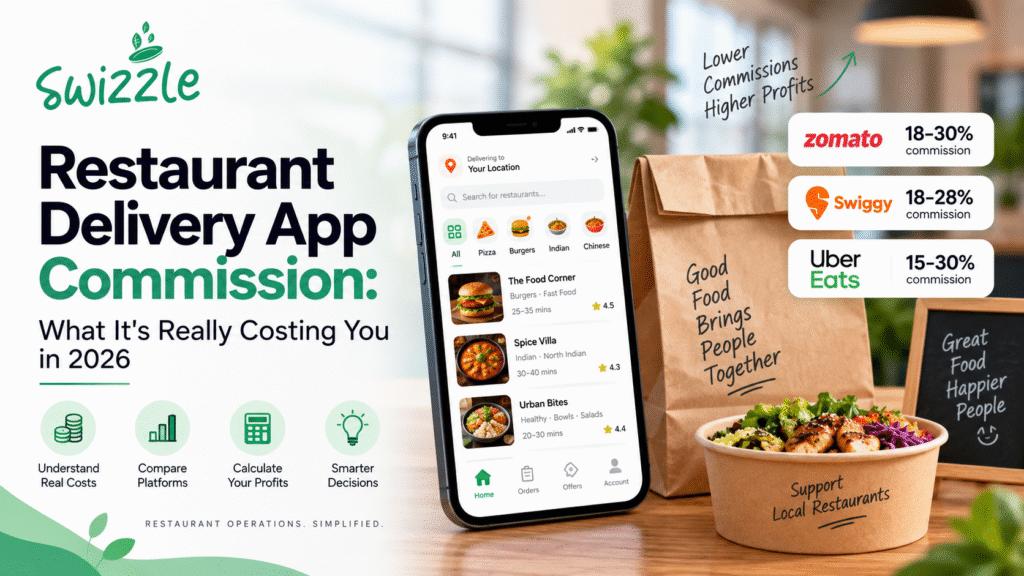
For restaurants operating in India, Swiggy and Zomato remain the two platforms that matter most, and industry data on 2026 payouts points to a fairly consistent range. A single-outlet restaurant on either platform typically sees commission land somewhere between 25% and 27% of order value once GST, payment gateway charges, and any campaign spend are layered in. Broken down further, Zomato’s base commission generally sits at 18-25% per order, with an additional 18% GST applied on the commission itself, while Swiggy’s base commission runs a comparable 18-28%, also taxed at 18% GST, with fast food and QSR categories typically landing at the higher end of that band.https://restaurantcoach.in/zomato-swiggy-commission-rates-2026/
https://www.dineopen.com/blog/reduce-zomato-swiggy-commission-restaurants.html
Stack every deduction together and the real number moves higher still: industry estimates put the combined cost of commission, tax, and fees at 25-35% of order value for most restaurant partners. That means a ₹500 order can realistically net the restaurant closer to ₹325-375 once everything is deducted — a gap that surprises even experienced operators the first time they reconcile it line by line.
DoorDash and Uber Eats Commission Rates
The picture looks similar outside India. DoorDash’s published pricing runs on a tiered model, with delivery commission ranging from around 15% on its entry-level plan up to 30% on its top tier, and pickup orders billed separately at roughly 6%. Uber Eats mirrors that structure closely, with delivery commissions also spanning 15-30% depending on the plan a restaurant selects. Once processing fees, required promotions, and refunds are factored into the total, industry analysts commonly put the effective cost restaurants actually pay at 30-40% of the order total — well above the headline number either platform advertises.
The takeaway across every market is the same: whatever commission figure a platform leads with, the real cost of fulfilling a delivery order is almost always higher, and the difference is rarely obvious until you go looking for it.
Why the Advertised Commission Isn’t Your Real Cost
Three things routinely widen the gap between the headline rate and your actual payout:
- Tax on commission. GST or sales tax is charged on the commission itself, not just the order value, quietly adding several percentage points.
- Promotional funding. Discounts and “free delivery” offers are frequently restaurant-funded, not platform-funded, even when the app presents them as a platform perk.
- Payment and packaging deductions. Gateway fees and packaging charges are subtracted before the commission is even calculated, shrinking the base you’re earning a percentage of.
Add GST on commission, packaging deductions, restaurant-funded discounts, and promotional contributions to the base rate, and the effective cost can climb to 30-40% of order value — a figure most owners only discover when they sit down and reconcile a full settlement statement against their sales dashboard rather than glancing at the commission line alone.
None of this is disclosed clearly upfront, and that’s by design rather than oversight. Platforms compete on the visible commission percentage because that’s the number restaurants compare when choosing where to list. The fees sitting quietly behind that number rarely make it into the sales pitch.
The Real Impact on Restaurant Margins
Restaurant margins were thin before delivery apps entered the picture, and commission has made the math tighter still. Industry benchmarks put the average independent restaurant’s net profit margin at just 3-5%, which means handing over 25-30% of online order revenue to a third-party app can erase that margin entirely on those specific orders — the restaurant may be busier, but not necessarily more profitable.
Run the numbers on a mid-sized operation: 100 delivery orders a day at an average ticket of ₹500 works out to roughly ₹15 lakh in monthly gross order value. At a blended 27% effective cost, that’s over ₹4 lakh a month leaving the business in commissions and fees alone — money that would otherwise cover rent, staff wages, or reinvestment in the dining room.
This is precisely why negotiation and diversification have become standard practice rather than a fringe strategy. Restaurants that come prepared with monthly order data, ratings history, and a competitor offer in writing regularly report negotiating a 2-5 percentage point reduction — a meaningful saving at volume, even if it doesn’t solve the underlying dependency on the platform.
To put that in perspective: on ₹3.6 lakh of monthly delivery GMV, even a 3-percentage-point reduction saves roughly ₹10,800 a month, or well over a lakh a year, for a conversation that typically takes one phone call and a spreadsheet.
What This Means If You’re Choosing Between Platforms
| Factor | Zomato / Swiggy (India) | DoorDash / Uber Eats (US) |
| Base commission | 18-28% | 15-30% |
| Tax on commission | 18% GST added on top | Sales tax varies by state |
| Effective cost after fees | 25-35% | 30-40% |
| Negotiation possible | Yes, above a volume threshold | Yes, mainly for multi-unit brands |
| Customer data ownership | Limited | Limited |
The pattern holds regardless of geography: base commission is only the entry point, and the effective cost is what actually determines whether a delivery order is profitable. A restaurant deciding between platforms — or deciding how much delivery volume to accept in the first place — should be comparing effective cost, not the number on the sign-up page.
How Restaurants Are Reducing Delivery App Commission Dependency
No restaurant can (or should) walk away from aggregators overnight — they still bring discovery and volume that’s genuinely hard to replace for a new outlet building its customer base. The realistic strategy is blending channels deliberately, rather than defaulting to whichever app is easiest to open.
Negotiate With Your Account Manager
High-volume restaurants have more leverage than they realize. Request a formal commission review, bring three months of order data and your rating history, and use a competing offer as a bargaining chip. Even a modest reduction compounds meaningfully across thousands of monthly orders.
Build a Direct Ordering Channel
Every order placed through your own website, app, or WhatsApp keeps 100% of the order value in your account and — just as importantly — gives you the customer’s contact details for future marketing. Aggregators rarely share that data, which means every order routed exclusively through them is also a missed chance to build a repeat customer.
Use QR Code and In-Table Ordering
For dine-in traffic, QR-based table ordering removes commission from the equation entirely while speeding up table turns. Guests order directly from their phone, payment is collected instantly, and the kitchen receives the ticket without a third-party markup sitting between the sale and your account.
Bundle Reservations, Ordering, and Loyalty Into One Platform
Fragmented tools — a reservation app here, a separate ordering system there, loyalty tracked on a spreadsheet — make it hard to see where commission is actually hurting you. A single platform that handles reservations, in-table ordering, payments, and loyalty together gives owners a clear, real-time view of which channel is genuinely profitable.
Why Swizzle Helps Restaurants Take Back Control
Swizzle was built around exactly this problem: restaurants losing visibility and margin across too many disconnected tools. Instead of juggling a reservations app, a delivery dashboard, a separate POS, and a spreadsheet for loyalty, Swizzle brings smart reservations, real-time kitchen tracking, integrated payments, online and table ordering, menu management, an analytics dashboard, and loyalty and promotions into one platform.
That matters directly for the commission conversation. A restaurant that can offer a smooth, branded ordering experience — QR-based in-table ordering plus a simple online storefront — keeps more repeat orders off aggregator platforms without asking guests to compromise on convenience. Swizzle’s analytics dashboard also makes it easy to see, order by order, which channel is actually driving profit versus which one is quietly funding someone else’s growth.
Where manual reservations lead to double bookings and lost tables, and juggling multiple tools slows down staff during a dinner rush, a single connected system removes both problems while giving owners the same real-time insight into performance that high-volume chains already use to negotiate better terms with aggregators.
[Internal link placeholder: link to Swizzle’s reservations feature page] [Internal link placeholder: link to Swizzle’s analytics dashboard page] [Internal link placeholder: link to a related Swizzle post on POS system selection]
Frequently Asked Questions
What is a typical restaurant delivery app commission rate in 2026? Base commission generally falls between 15% and 30% of order value, depending on the platform, city, and plan tier. After GST, payment processing, and promotional deductions, most restaurants report an effective cost closer to 25-35% once every fee is accounted for.
Why is my actual payout lower than the advertised commission rate? Tax charged on the commission itself, restaurant-funded promotions, and payment or packaging deductions all sit on top of the base commission. These combine to push the real cost per order several percentage points above the headline rate.
Can restaurants negotiate their delivery app commission? Yes. Restaurants with consistent volume, strong ratings, and a written competitor offer regularly negotiate a 2-5 percentage point reduction by requesting a formal review from their account manager.
Is it worth building a direct ordering channel instead of relying on delivery apps? For restaurants with a meaningful share of repeat customers, yes. Every order placed directly avoids commission entirely and gives the restaurant customer data that aggregators typically don’t share, making future marketing far more effective.
Do delivery app commissions vary by cuisine or restaurant type? Yes. Categories like quick-service and fast food often see rates at the higher end of the range, while some premium or high-volume restaurants negotiate lower tiers based on order history and exclusivity terms.
Conclusion
Restaurant delivery app commission isn’t going away, and for most restaurants, aggregators will remain part of the ordering mix in 2026. But treating the advertised rate as the full story is where margin quietly disappears. Know your real effective cost, negotiate where you have leverage, and build direct channels — reservations, in-table ordering, and loyalty — that keep your most loyal guests off someone else’s commission structure. That’s the shift that protects margin for good, not just for one renegotiated quarter.